Aleph Talk — a 60-Day Hebrew Course on iOS and Android
Client: Edgesys Technologies (in-house product)
A Hebrew course with an end date: 60 numbered days from the aleph-bet to conversation, explained in Malayalam, Hindi or Sinhala rather than through English. One Flutter codebase on the App Store and Google Play, served by the same Laravel API that runs the product site.
Key outcomes
Inside the app
The Problem
Someone in Kerala or Colombo who wants to learn Hebrew opens the app store and finds courses that teach it through English. For a Malayalam or Sinhala speaker that means translating twice — Hebrew into English, English into the language they actually think in — and the second translation is where the meaning gets lost. It is a tax paid on every single word.
Hebrew adds difficulties that a phrasebook app cannot skip past:
- It is an unfamiliar 22-letter script, read right to left.
- Vowels are written as marks under the letters (nikud) and are then routinely left out of real Hebrew, so a learner has to read both with and without them.
- Several letters are near-homophones to an untrained ear, which makes audio non-optional rather than a nice extra.
And underneath the language problem sits the one every learning app really has: people quit. An endless feed of exercises has no finish line, so there is never a day on which a learner feels they have arrived. Content was never the constraint. Turning up on day 34 was.
The Solution
A course with a shape, and an end
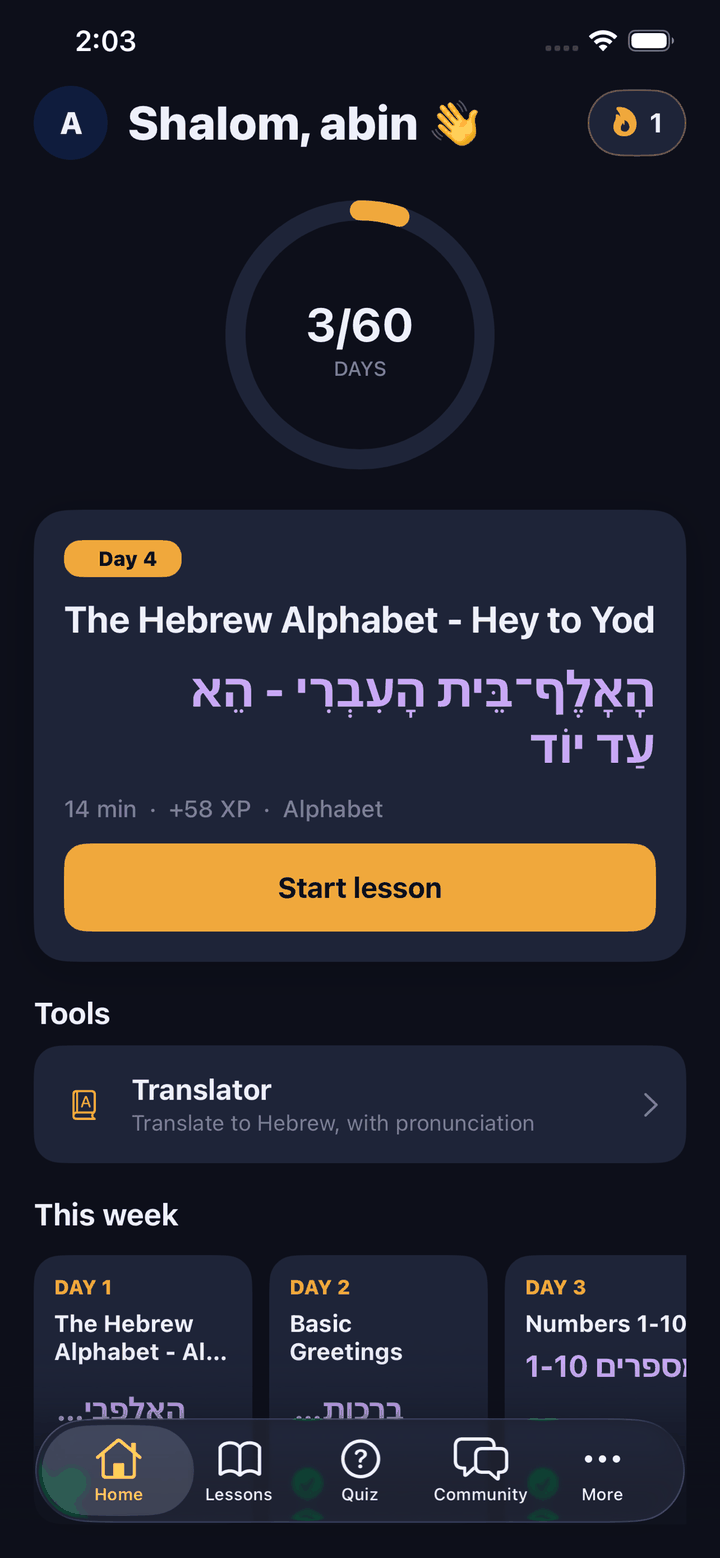
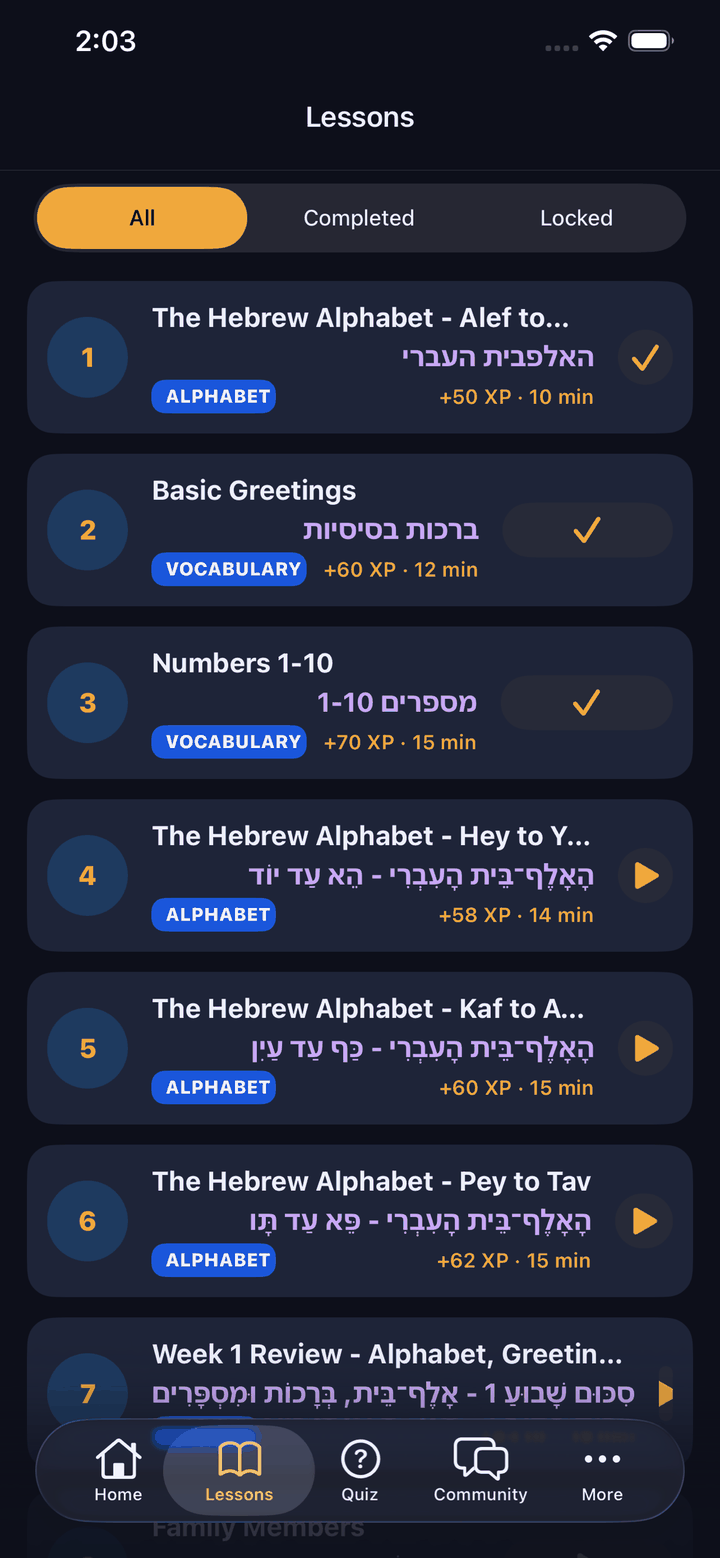
Sixty numbered days, in fixed order, each building on the last — the alphabet first, then everyday vocabulary, then sentences a learner can actually use, with a review lesson closing each week. The number is the product: sixty is long enough to reach conversation and short enough to picture finishing.
Explained in the learner's own language
Every word carries its Hebrew script with vowel marks, a transliteration, and a translation in Malayalam, Hindi or Sinhala. Nothing routes through English on the way. This is the reason the product exists, and it is the part a generic global app has no commercial reason to build.
Nothing is left silent
Tap any word or phrase to hear it. Where a recording exists the learner hears a real voice; everywhere else the device's own speech synthesis reads the Hebrew aloud. Recording sixty days of vocabulary before launch would have meant not launching, and a learner tapping a word and getting nothing back is worse than a synthesised voice.
The quiz is the gate
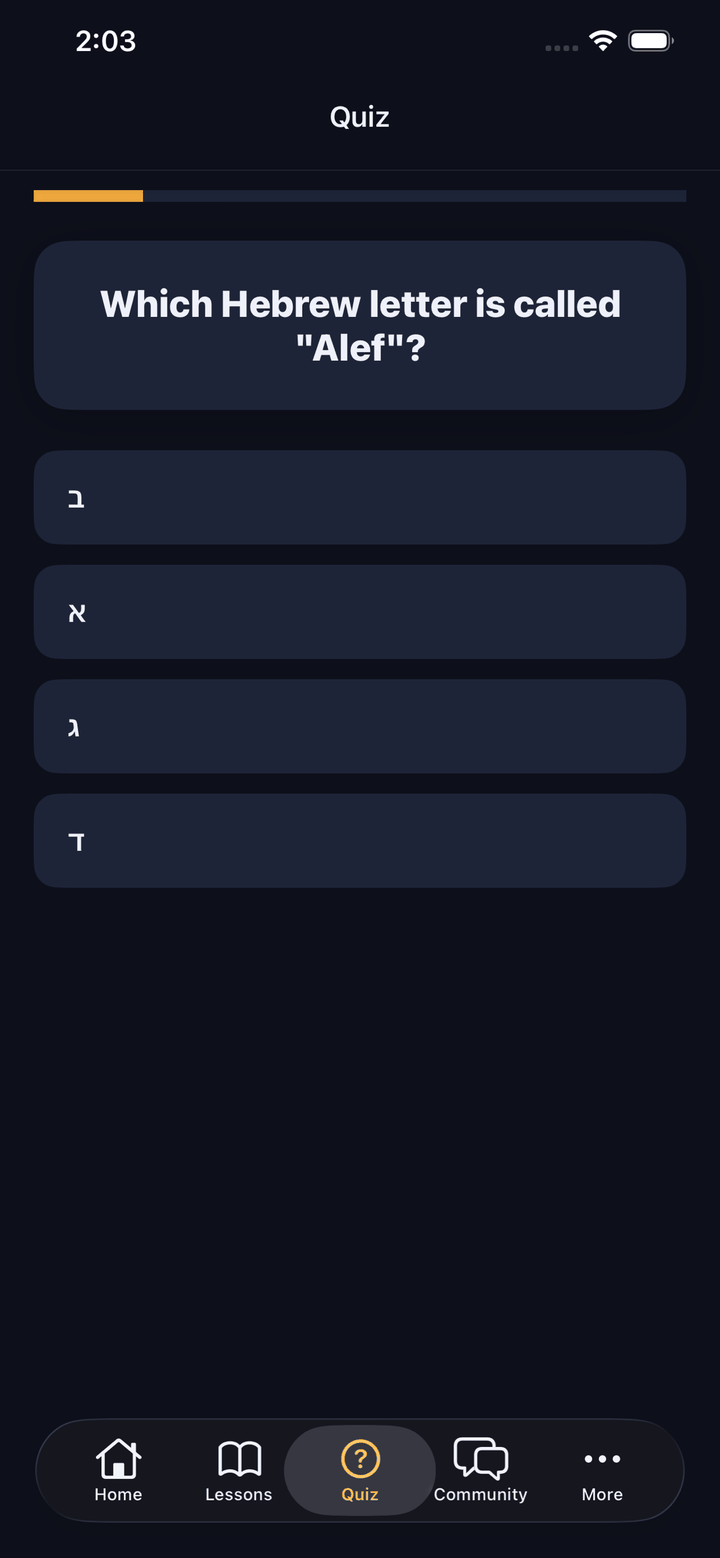
Each day ends in a short multiple-choice quiz. Answering it is what marks the day complete, advances the streak and adds XP — so progress records comprehension rather than scrolling. Levels, an XP bar and a weekly leaderboard sit on top of the same numbers.
Progress you can see all of at once
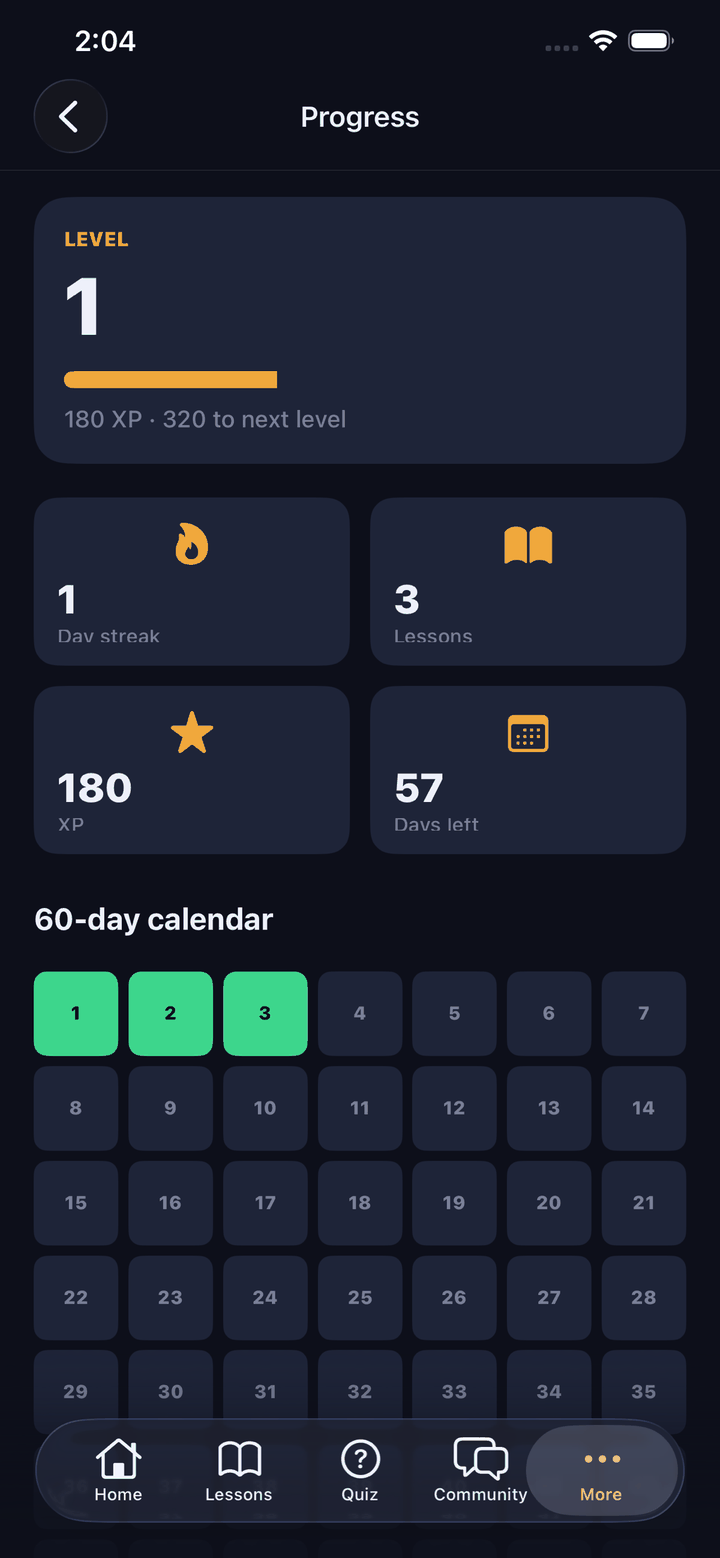
A ring on the home screen shows days completed against sixty. The progress screen breaks it out into streak, lessons, XP and days remaining, above a sixty-square calendar. Making the whole course visible in one grid is what turns an abstract habit into something with a visible gap in it when a day is missed.
A forum where the questions already are
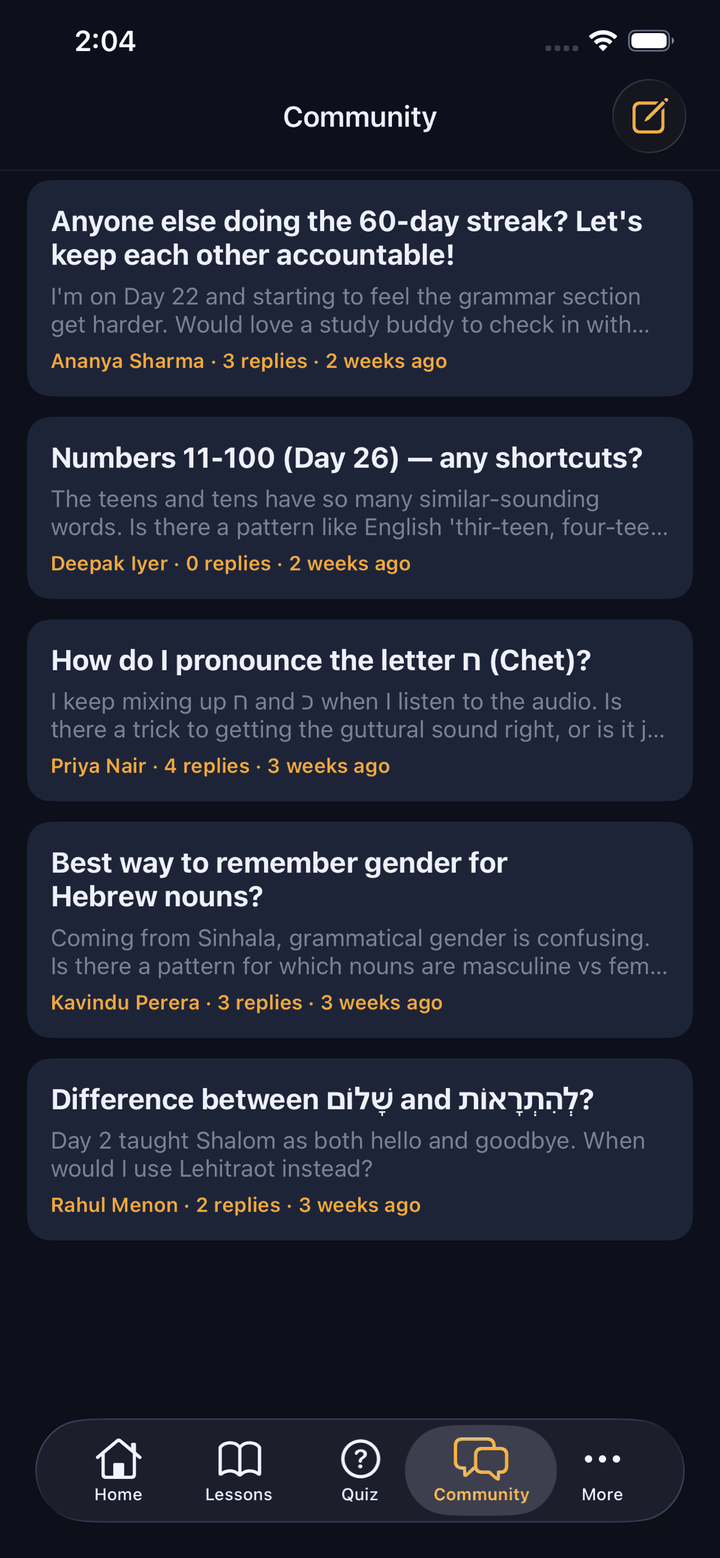
Beginners get stuck on a small, predictable set of things — how to pronounce ח, whether שלום works for goodbye, how noun gender behaves for a Sinhala speaker who has never met it. An in-app community with threaded replies keeps those answers beside the lessons that raise them instead of scattered across a chat group.
One Flutter app, one Laravel API
The client is a single Flutter codebase published to both the App Store and Google Play. Behind it is the same Laravel application that serves alephtalk.com — one database holding lessons, quizzes, streaks, XP, the leaderboard and the community, so the site and the app can never disagree about a learner's progress and an account picks up on a new phone exactly where it stopped.
The Outcome
Aleph Talk is live and publicly downloadable on both stores — on the App Store for iOS 16 and later (also running on iPad and on Apple Silicon Macs) and on Google Play under com.edgesys.alephtalk, in the Education category, rated 4+ / Everyone.
The full sixty-day course, the quiz and streak system, the progress calendar, the community and the translator tool all shipped. A free tier carries a learner through the first half of the course; the paid tier opens the remainder.
The app is new enough that store ratings are not yet meaningful, so there are no adoption figures quoted on this page. What can be shown is the build: a structured course, three native explanation languages, two stores, and one backend serving both the app and the website.
Tech stack
Why the lessons live on the server
A language course is never finished. A missing vowel point changes a word, a transliteration reads wrong to one language group and fine to another, an example sentence turns out to be stilted. If that content were compiled into the app, every correction would wait on store review — days for a typo.
So lessons, quizzes and their translations are delivered by the Laravel API, and the Flutter client renders whatever it is given. Content fixes go live the moment they are saved. Store releases are then reserved for what actually needs one: new screens and new behaviour.
Right-to-left is a layout problem, not a font problem
Hebrew rendered inside a Malayalam or English interface means two text directions on the same screen — a right-aligned Hebrew title above a left-aligned duration and XP row, punctuation that has to land on the correct end of a mixed-script line, and vowel marks that must not be clipped by line height tuned for Latin text. Getting this right is unglamorous and immediately obvious when it is wrong.
A note on the screenshots
These are Aleph Talk's own published App Store screenshots. The community threads in them are the demo content prepared for the store listing, not posts by real learners — the names and questions shown are illustrative. Nothing on this page is a live user's data.
What generalises to other learning products
Three decisions here transfer to any course-shaped app:
- Give the course a length. "Sixty days" is a promise a learner can hold in their head; "keep practising" is not. The finish line does more for completion than any additional feature.
- Never let an interaction fail silently. A recorded voice where one exists and synthesis everywhere else beats waiting until the whole library is recorded — and beats a tap that does nothing.
- Keep editable content out of the binary. Anything a subject-matter expert will want to correct belongs behind an API, or the release cycle becomes the bottleneck on quality.
And one that is specific to this market: teaching through the learner's first language is not a localisation task bolted on at the end. It is the product.
Have a similar project in mind?
Let's talk about your requirements. Free 30-minute discovery call.
Start a ProjectMore case studies
School ERP Platform for 7+ Institutions in Kerala
Full-featured school management platform with 75+ modules serving 7+ Kerala institutions across CBSE, ICSE, an...
Web ApplicationLegal Practice Management System
Secure Laravel-based case management system with document handling, client tracking, and a 5-star security aud...
POS SystemRestaurant POS & Digital Menu System
Order management, kitchen display, digital QR menu, and GST-compliant billing — rolled out across 4 outlets in...