Multi-Branch ERP for a Heavy Equipment Spare Parts Distributor
Client: Access Point
A single ERP replacing separate billing, stock and accounting tools for a multi-branch spare parts distributor — GST-compliant invoicing, 8,000+ tracked parts across brands and models, and double-entry accounting that produces a real trial balance, profit & loss and balance sheet.
Key outcomes
Inside the system
The Problem
Distributing spare parts for heavy equipment is an inventory problem before it is a sales problem. A single counter sale might involve a filter for a Weichai engine, a seal kit for a winch reducer and a cabin part for a specific crane model — each identified by a manufacturer part code, each stocked in different quantities, each belonging to a different brand and machine model.
Businesses at this size usually end up running three systems that do not talk to each other: a billing package that prints GST invoices, a spreadsheet that tracks stock, and an accountant who reconciles both at the end of the quarter. The costs of that split are predictable:
- Counter staff cannot see live stock, so they promise parts the branch does not have.
- Stock valuation is a guess between physical counts, and slow-moving capital is invisible.
- GST returns depend on re-keying, which is where mistakes and penalties come from.
- There is no single answer to "what did this branch actually earn last month", because sales sit in one system and expenses in another.
- Adding a branch means duplicating the whole arrangement rather than extending it.
The Solution
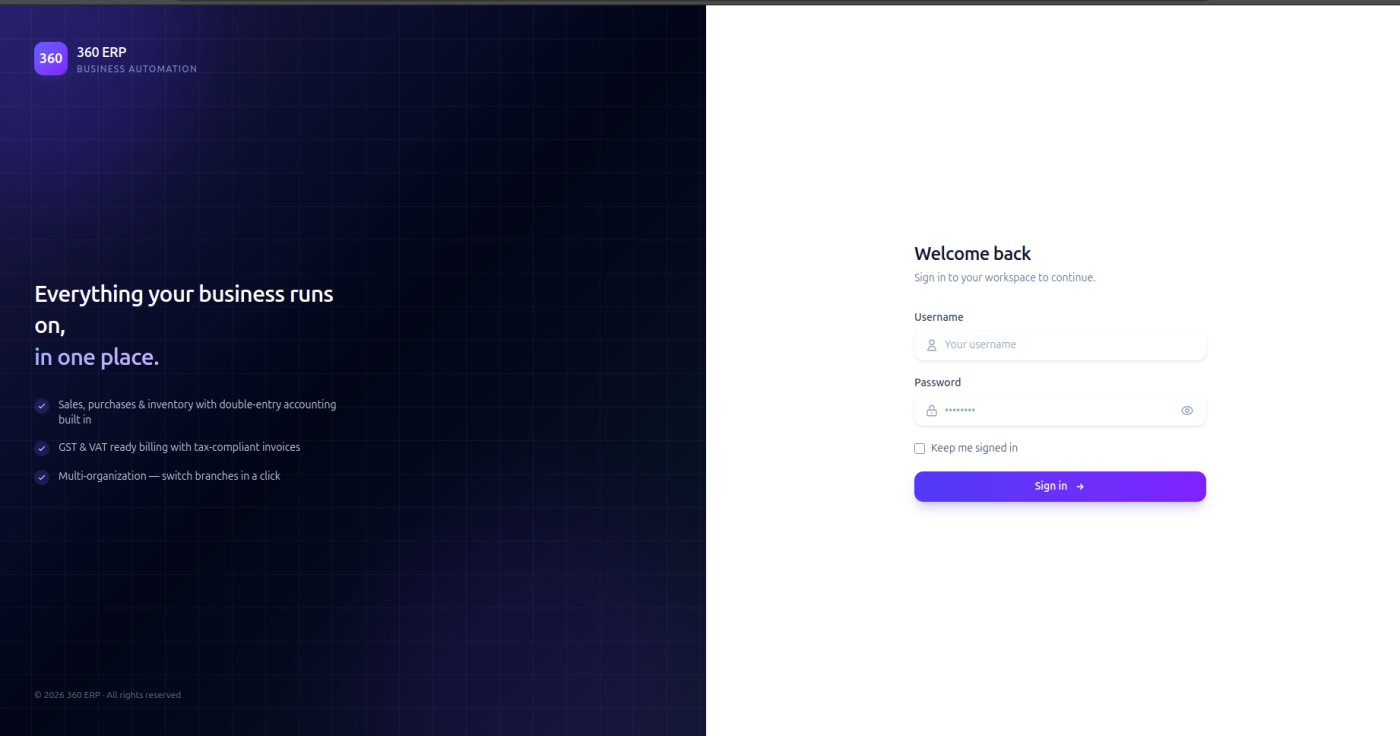
360 ERP replaces that arrangement with one application where a sale, the stock movement it causes and the journal entry it produces are the same event recorded once.
Built for multi-branch from the start
Every record belongs to an organisation, and users switch between branches from the header without signing out or maintaining a second login. Reports scope to the branch you are in, so a manager sees their own numbers and an owner can compare.
Parts catalogue that matches how the trade works
Items are organised by category, brand and machine model, and carry the manufacturer part code as well as an internal code — so a counter search for 62240 and a search for fuel filter Weichai WP10H both land on the same part. Item locations and item movement track where stock physically sits and every transfer between branches.
Sales documents in the order the trade uses them
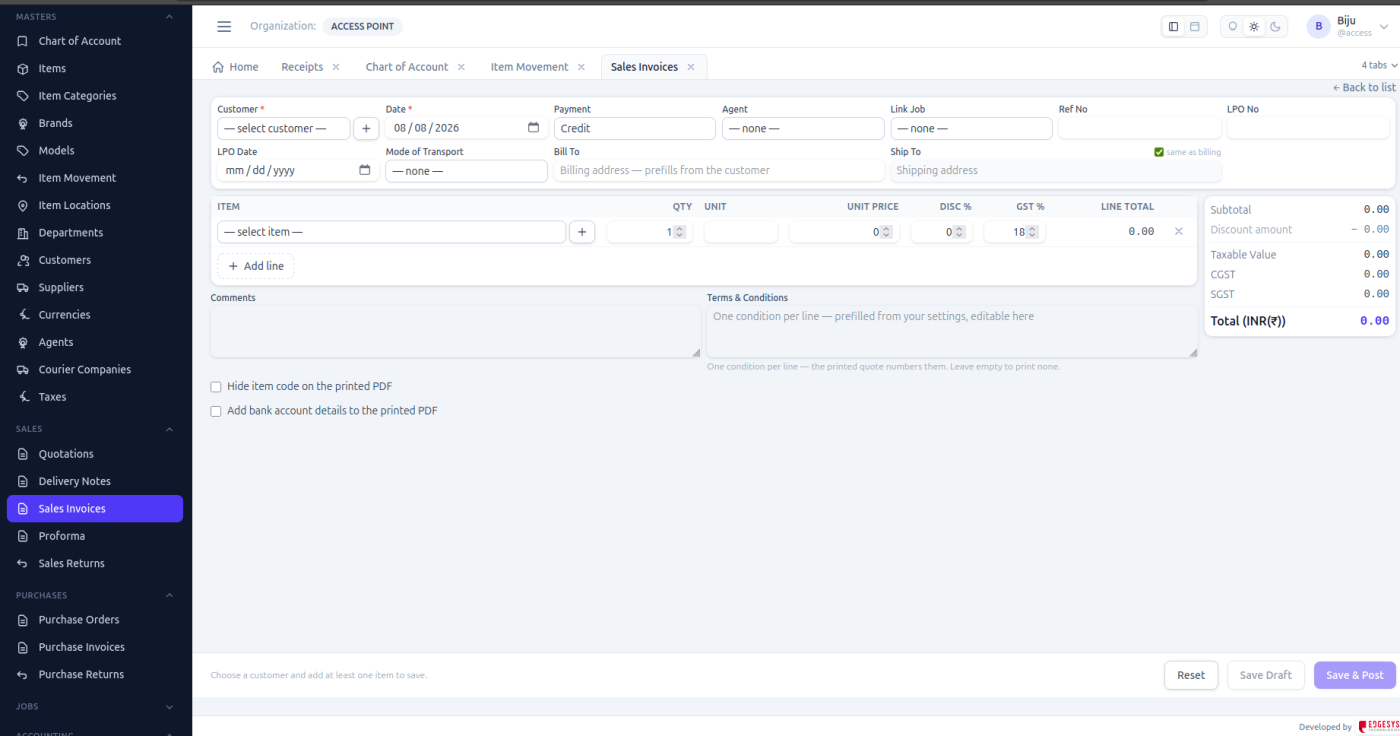
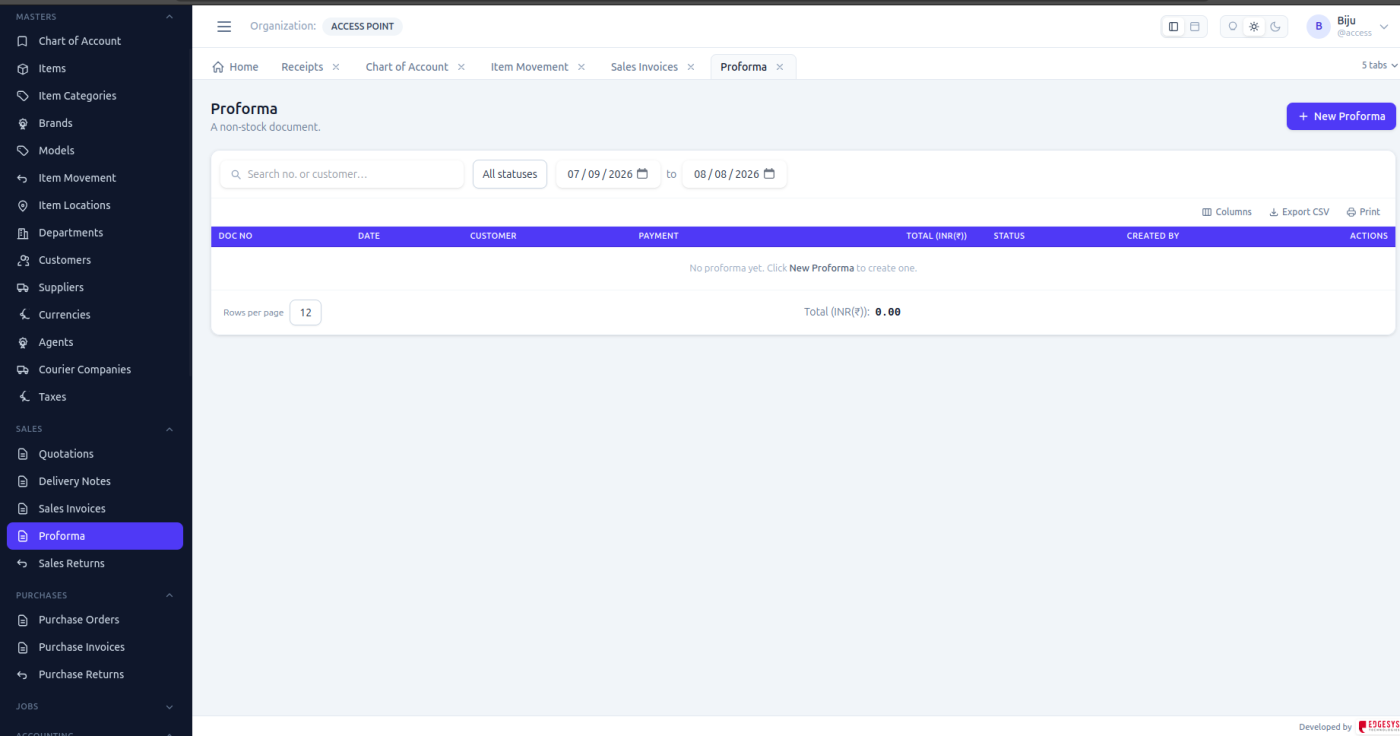
Quotation, proforma, delivery note, sales invoice and sales return, each converting into the next. Proforma exists as a genuinely non-stock document, so quoting a customer neither reserves inventory nor posts to the ledger. Invoices capture the details this industry actually needs — LPO number and date, mode of transport, courier company, agent, and a shipping address separate from billing.
Tax handled at the line, not the total
GST percentage and discount are set per line, with CGST, SGST and IGST separated automatically and taxable value carried through to the returns. The printed PDF is configurable — item codes can be hidden from a customer-facing copy, and bank details added when the invoice doubles as a payment request.
Real double-entry accounting underneath
A chart of accounts, receipts, payments and vouchers sit under the trading documents, so the books are not a separate exercise. The system produces trial balance, profit & loss, balance sheet and cash flow directly from posted entries, along with account closure and fixed asset depreciation.
Reporting aimed at working capital
Beyond the statutory reports, the modules that matter day to day are the inventory ones: stock balance, stock movement, inventory ageing bucketed by 0–30, 31–60, 61–90 and 90+ days, outstanding invoices, and statements of account. Sales reporting breaks down by counter, by item and by job, which is how a distributor works out which lines to reorder and which are dead capital.
Interface built for people who live in it all day
The workspace is tabbed — a user can keep the dashboard, a chart of accounts, an item movement report and an invoice open at once and move between them, the way a counter operator actually works. Light and dark themes are both supported, and every report grid exports to CSV or prints.
The Outcome
The system is live and in daily use, running a catalogue of more than 8,000 tracked parts across brands and machine models.
The concrete change is that billing, stock and accounting are now one dataset. An invoice raised at the counter reduces stock, updates the customer's outstanding balance and posts to the ledger in the same action — so the dashboard figure for receivables, the inventory ageing report and the balance sheet are all describing the same reality rather than three approximations of it.
Because organisations are a first-class concept rather than a workaround, adding a branch is configuration rather than a second deployment.
Why an ERP rather than off-the-shelf accounting software
Standard accounting packages handle the ledger well and the warehouse badly. They have no concept of a machine model, no place for a manufacturer part code alongside your own, and no way to describe a delivery note that becomes an invoice that becomes a return. For a parts distributor those are not edge cases, they are the daily work.
Building around the trade instead of adapting the trade to the software is the whole argument for a custom ERP — and it only pays off when the accounting underneath is genuinely double-entry, so the business never has to choose between operational software and books that balance.
Considering something similar?
The parts of this build that generalise to most distribution and multi-branch businesses are the ones worth planning first: one item master with the codes your suppliers and customers actually use, documents that convert into one another rather than being re-keyed, tax computed per line, and reporting that answers working-capital questions rather than only statutory ones.
Have a similar project in mind?
Let's talk about your requirements. Free 30-minute discovery call.
Start a ProjectMore case studies
School ERP Platform for 7+ Institutions in Kerala
Full-featured school management platform with 75+ modules serving 7+ Kerala institutions across CBSE, ICSE, an...
Web ApplicationLegal Practice Management System
Secure Laravel-based case management system with document handling, client tracking, and a 5-star security aud...
POS SystemRestaurant POS & Digital Menu System
Order management, kitchen display, digital QR menu, and GST-compliant billing — rolled out across 4 outlets in...