Matrimony Platform and Admin CRM for a Faith Community
Client: Born Again Matrimonial
A faith-specific matrimony platform — public site, member mobile app and a full back-office CRM — covering registration, photo and ID verification, preference-based matching, subscriptions and the call-centre follow-up a matchmaking business actually runs on.
Key outcomes
Inside the system
The Problem
Matrimony is a trust product before it is a software product. People are handing over their photograph, their family background, their faith and their phone number, and the reason they leave a platform is almost always the same: fake profiles, or nobody replying.
For a specific faith community the problem is sharper again. Mainstream matrimony portals treat denomination as a single dropdown value, so a Pentecostal or Born Again member wading through them filters by "Christian" and gets nothing useful. The alternative — community WhatsApp groups and word-of-mouth brokers — carries genuine trust but does not scale past a few hundred people and keeps no record of anything.
Building the software is the easy half. The hard requirements are the ones that are operational rather than technical:
- Every profile has to be verified by a human, not just by an email link.
- Photographs need approving before they go live, because that is where abuse enters.
- Members who stop halfway through a profile need chasing, or they never get matched and blame the platform.
- Deletion has to be handled properly and logged — this is sensitive personal data, and people change their minds.
- Someone has to actually telephone members. A matchmaking business that only sends emails does not convert.
The Solution
The platform is three connected products: a public site, a member mobile app, and a back-office CRM that is considerably larger than either.
Public site built around search
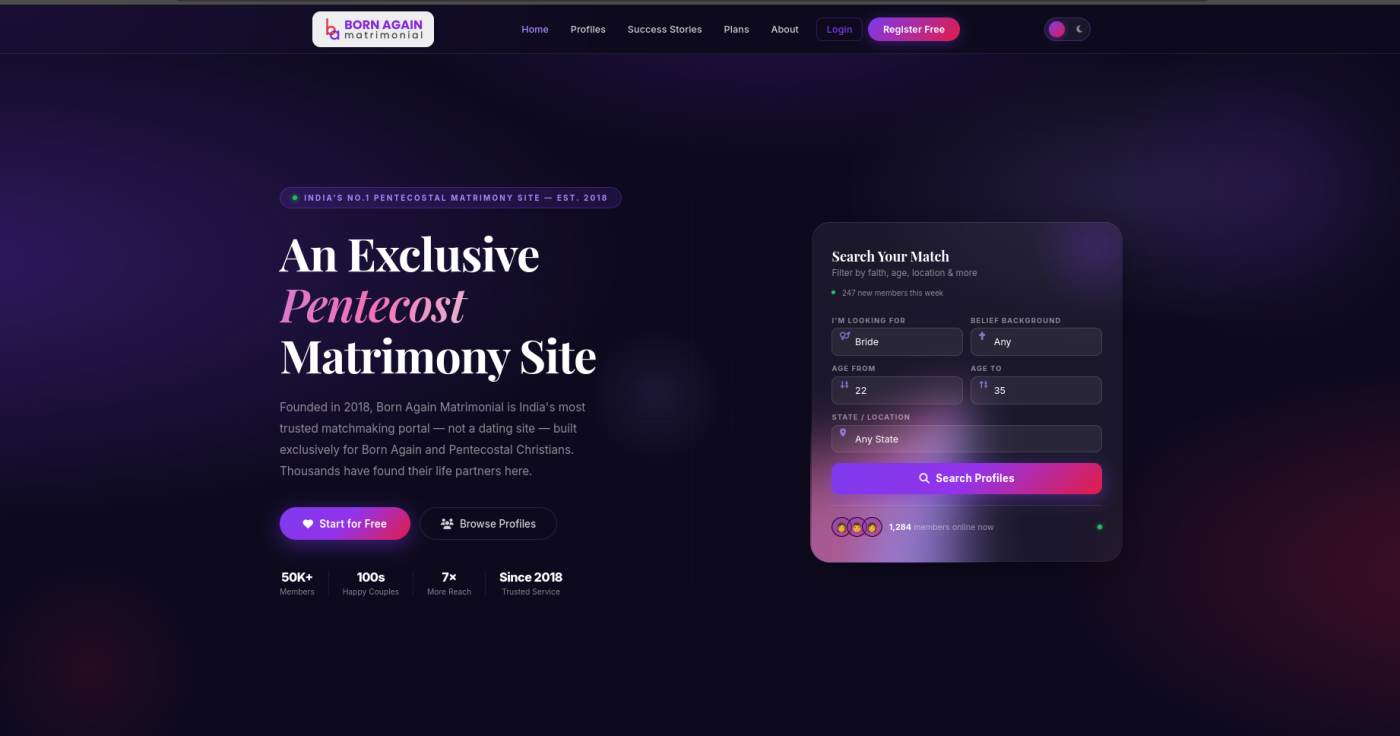
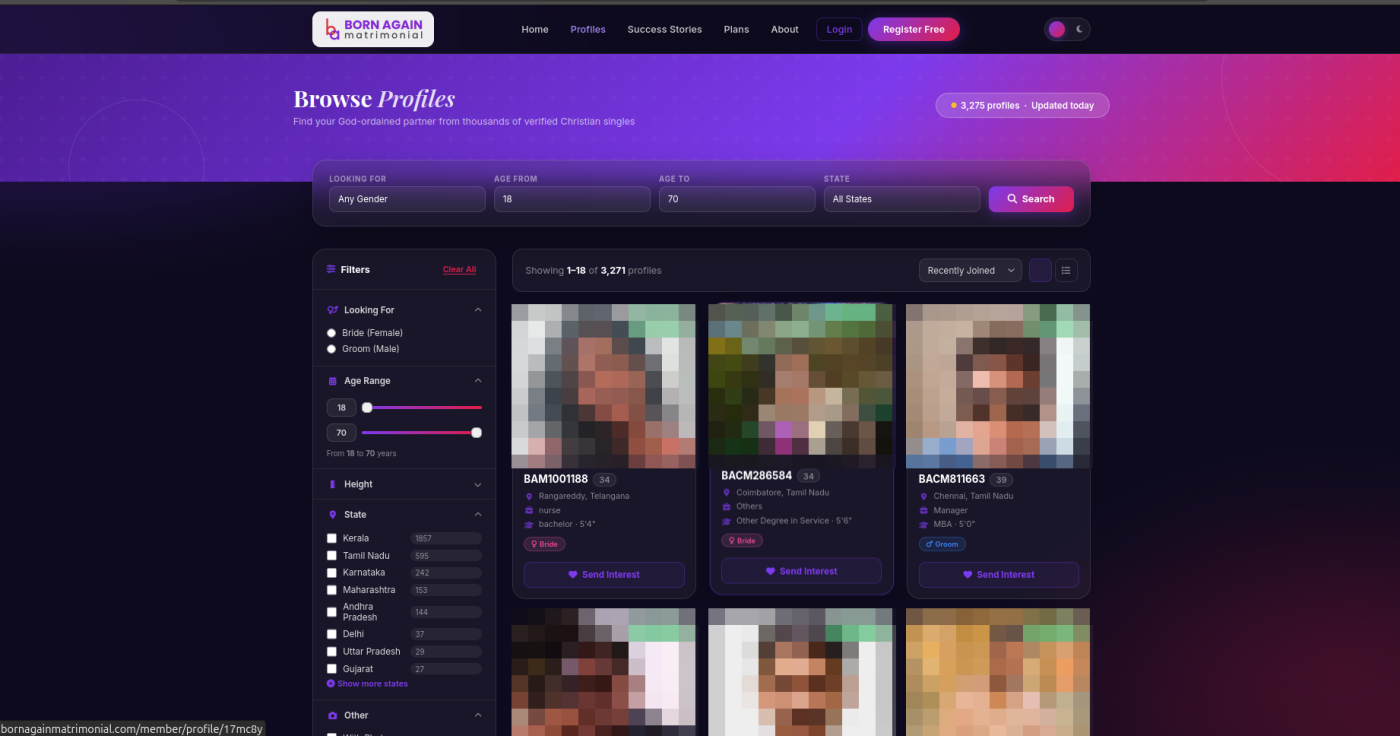
The match search sits in the hero rather than behind a sign-up wall — gender, belief background, age range and state, immediately. Browsing shows verification badges, a profile ID, city, occupation, education and height, and deliberately withholds names until both sides have connected. Filters cover age, height and state, with member counts shown per state so the search feels populated rather than empty.
Membership tiers that gate the right things
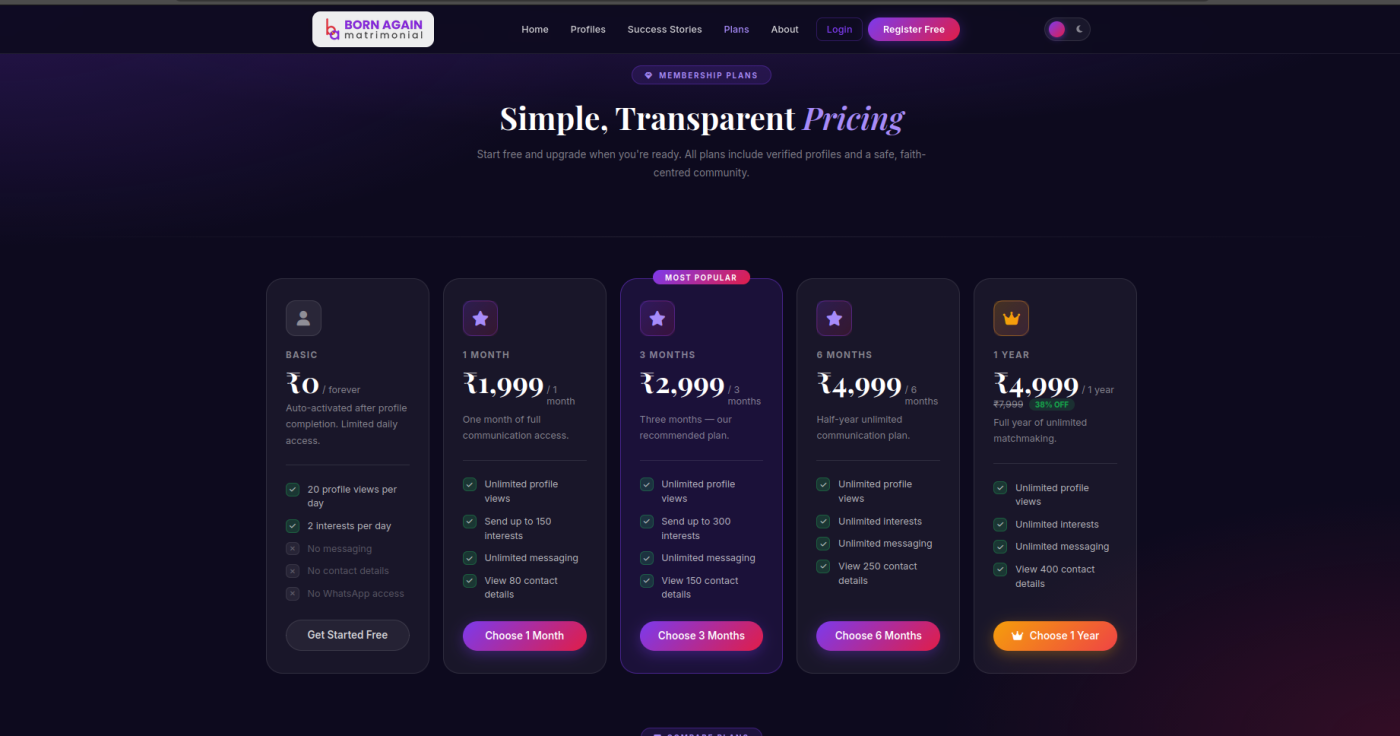
The free tier stays genuinely useful — a capped number of profile views and interests per day — while paid plans unlock messaging, contact detail views and WhatsApp access in increasing allowances. Gating contact details rather than browsing is the model that fits matrimony: people need to see the pool is real before they will pay.
Preferences with the detail the community matches on
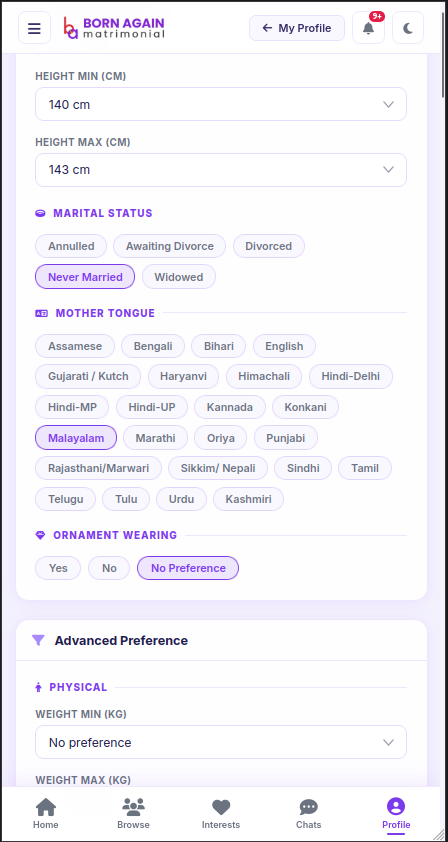
Partner preferences go well past age and location: height ranges, marital status with the distinctions that matter here (never married, widowed, divorced, annulled, awaiting divorce), mother tongue across more than twenty Indian languages, ornament wearing, and further physical preferences. This is the part generic platforms get wrong, and it is the reason a community-specific product exists at all.
Mobile app centred on profile completeness
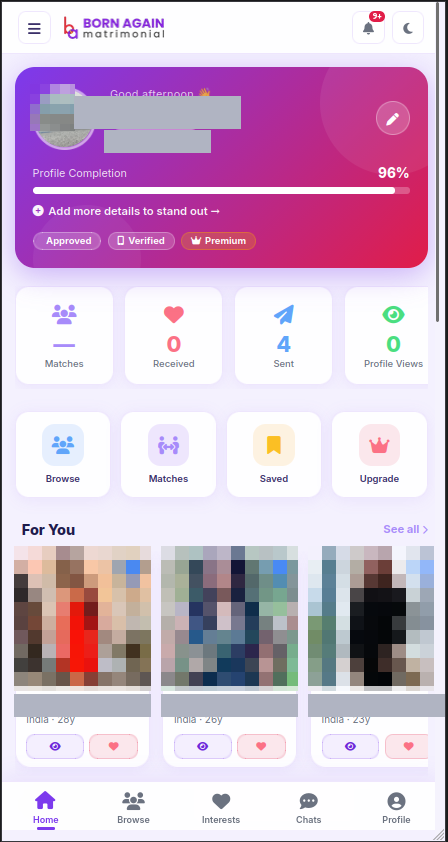
The member app opens on a profile completion percentage with approval, verification and premium badges, then counters for matches, interests received and sent, and profile views. Completeness is foregrounded because an incomplete profile is the single strongest predictor of never getting a reply. Underneath sit browse, matches, saved profiles, chats, notifications and an activity summary that states plainly that interaction records are permanent.
The admin CRM is the real system
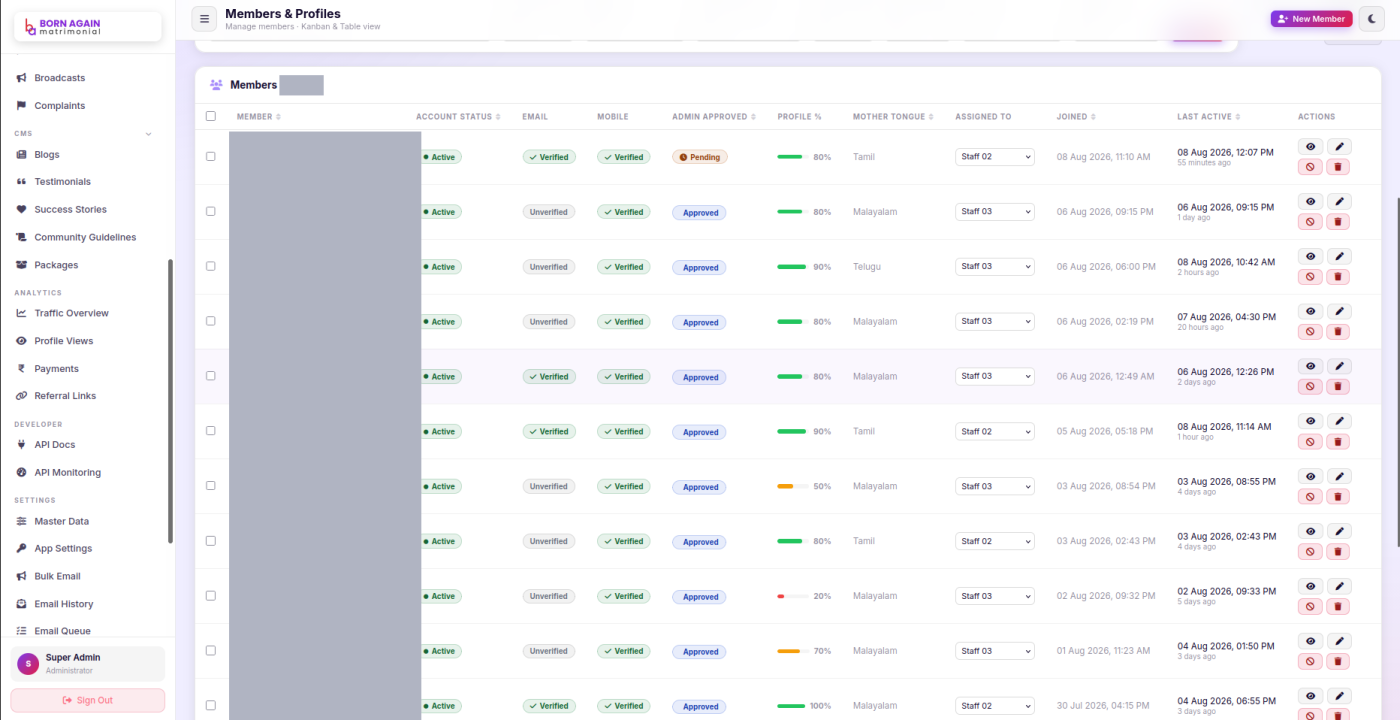
Member management tracks account status, email verification, mobile verification and manual admin approval as separate states, alongside profile completion percentage, mother tongue and an assigned staff owner — so no member is nobody's responsibility.
Around that sit photo approvals, deletion requests with a deletion log and a separate staff deletion request queue, subscriptions and packages, a featured bride/groom of the day, complaints, broadcasts and tasks.
Call operations, treated as a first-class feature
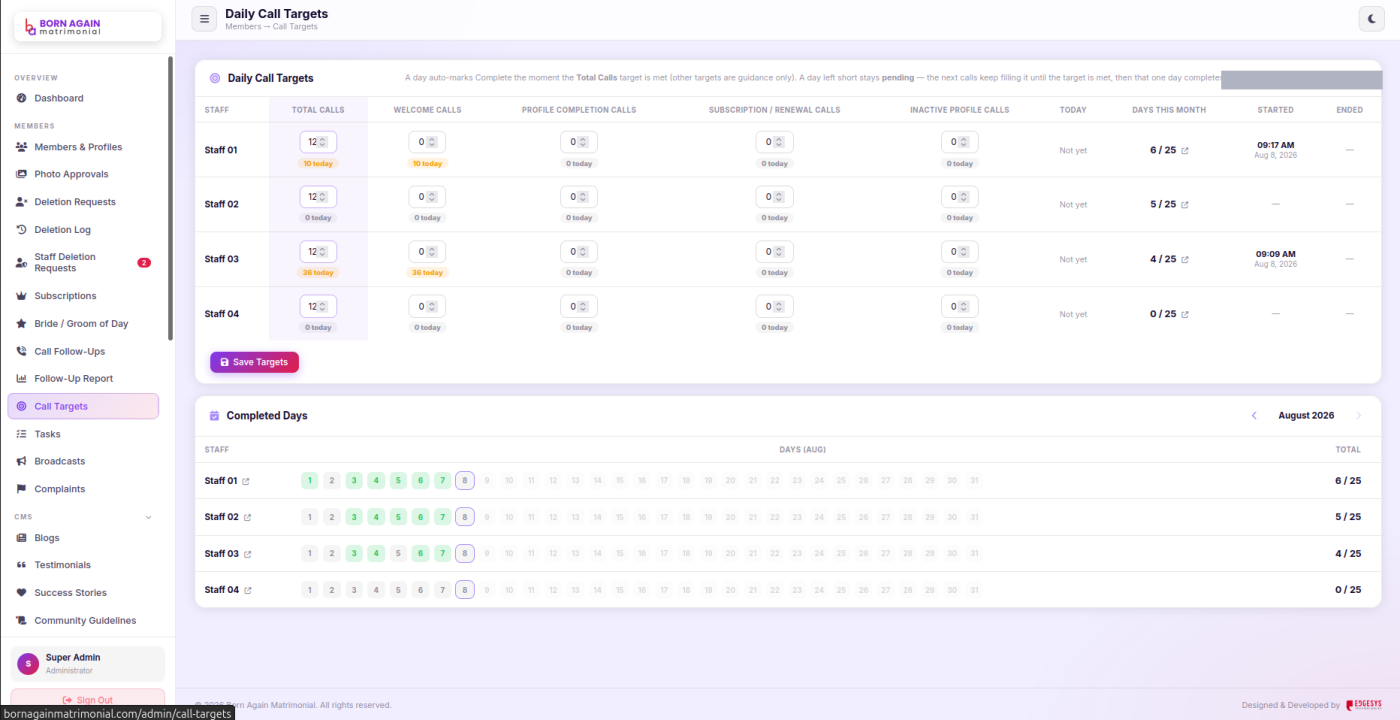
Matchmaking converts on the telephone, so the CRM includes daily call targets per staff member split by purpose — welcome calls, profile completion calls, subscription and renewal calls, inactive profile calls — tracked against a monthly completion calendar, with follow-up reports and call logs behind it.
Content, analytics and operations
A CMS covers blogs, testimonials, success stories and community guidelines. Analytics cover traffic, profile views, payments and referral links. Operational tooling includes master data, app settings, bulk email with a queue and history, and API documentation and monitoring for the mobile client.
The Outcome
The platform is live and running the complete member lifecycle in one system — registration, human verification, preference-based matching, subscription payment, and the outbound call operation that turns a signed-up member into a matched one.
The part that matters most is the least visible: because verification state, staff assignment, call targets and deletion handling all live in the same application as the member data, the team's daily work and the members' experience are describing the same records. There is no separate spreadsheet of who to call.
A note on the screenshots
Every image on this page has been redacted before publication. Member names, email addresses and photographs are covered with opaque blocks or heavily pixelated, and internal figures have been removed. The people on a matrimony platform consented to appear on that platform — not in a developer's portfolio — and a case study is not a reason to widen that consent.
What generalises to other community platforms
Most of this build applies to any membership product where trust is the constraint rather than features: separate the verification states instead of collapsing them into one "verified" flag, assign every member to a human owner, log deletions rather than performing them silently, and treat the operations team's daily workflow as part of the product rather than something they improvise in a spreadsheet.
The commercial lesson is narrower but just as portable: gate contact, not discovery. Letting people see that the pool is real, and charging when they want to reach into it, is what makes a subscription model work in matchmaking.
Have a similar project in mind?
Let's talk about your requirements. Free 30-minute discovery call.
Start a ProjectMore case studies
School ERP Platform for 7+ Institutions in Kerala
Full-featured school management platform with 75+ modules serving 7+ Kerala institutions across CBSE, ICSE, an...
Web ApplicationLegal Practice Management System
Secure Laravel-based case management system with document handling, client tracking, and a 5-star security aud...
POS SystemRestaurant POS & Digital Menu System
Order management, kitchen display, digital QR menu, and GST-compliant billing — rolled out across 4 outlets in...